From American Profile.com. Some interesting facts.
INDIANA-- Oldenburg (pop. 647) was incorporated in 1869 by German settlers. Called "Village of Spires" because of its many churches.
IOWA-- Exira (pop. 810) has "The Plow in the Oak Tree. The handles and part of the blade stick out of a live bur oak. Legend has it that a farmer was plowing his field when Union soldiers passed by on their way to the Civil War. He leaned the plow against a sapling, joined the soldiers and the tree grew around it.
Good story. I'll have to check it out next time through.
MISSOURI-- Cuba (pop. 3,230) has the world's largest rocking chair a little ways west of town on Route 66 at the Fanning US--66 Outpost and General Store where you can also get your Route 66 wine. This is a new attraction along the old road.
Cuba is also called the City of Murals and has an authentic Route 66 motel on the 1920s Wagon Wheel Motel with its giraffe stone.
OHIO-- Columbus is home of the nation's largest college campus by enrollment at Ohio State University with 53,715 students. I am not a Buckeye fan at all, however.
Columbus and OSU have a connection to the Buffalo Wild Wings restaurant chain. Two Ohio Stae students from Buffalo, NY, were not happy with the wings around Columbus and started the chain.
Always Something Interesting. --RoadDog
Tuesday, December 29, 2009
Monday, December 28, 2009
How Bleak is Route 66's Future?-- Part 2
Back to the March-April 2008 Preservation magazine article.
Two articles accompanied the pictures. The first one, "Scenes from an Open Road" by Ann Beattie, did a great job summing the old road in my opinion.
"Route 66 was the Romantics' toad, an optimistic road, the 'Mother Road,' as John Steinbeck called it in The Grapes of Wrath. It was going to stretch thousands of miles and provide travelers with unique places to eat and to spend the night as they made their journeys, their individual journeys that nevertheless took them to many of the same places accomplishing something, or perhaps searching for the holy grail of relaxation.
It was a road that had pride of place, and also a sense of humor: The neon signs you found there were illustrative, but many were created to amuse. If the Saturday morning cartoons appealed to the kids, the cowboys on bucking broncos and 10-foot-high hamburgers dripping neon-red ketchup, pointing to diners along Route 66, were there to make the grownups smile.
The signs were either so understated they were plaintive ('vacancy'), or they were happily hyper; the leaping lizards and sky-high ladies whirling lassos described something that wasn't exactly true, but wasn't entirely false, either. The wonderlands they blinked at and pointed to were outdoor graphic novels: The talk and visuals were interrelated; the world was telling its story and you-- assuming you weren't too cool to converse-- were telling yours."
Man, I sure wish I could write like this, but that will never happen.
Great summation Ann Beattie.
Still Gettin' My Kicks. --RoadDog
Two articles accompanied the pictures. The first one, "Scenes from an Open Road" by Ann Beattie, did a great job summing the old road in my opinion.
"Route 66 was the Romantics' toad, an optimistic road, the 'Mother Road,' as John Steinbeck called it in The Grapes of Wrath. It was going to stretch thousands of miles and provide travelers with unique places to eat and to spend the night as they made their journeys, their individual journeys that nevertheless took them to many of the same places accomplishing something, or perhaps searching for the holy grail of relaxation.
It was a road that had pride of place, and also a sense of humor: The neon signs you found there were illustrative, but many were created to amuse. If the Saturday morning cartoons appealed to the kids, the cowboys on bucking broncos and 10-foot-high hamburgers dripping neon-red ketchup, pointing to diners along Route 66, were there to make the grownups smile.
The signs were either so understated they were plaintive ('vacancy'), or they were happily hyper; the leaping lizards and sky-high ladies whirling lassos described something that wasn't exactly true, but wasn't entirely false, either. The wonderlands they blinked at and pointed to were outdoor graphic novels: The talk and visuals were interrelated; the world was telling its story and you-- assuming you weren't too cool to converse-- were telling yours."
Man, I sure wish I could write like this, but that will never happen.
Great summation Ann Beattie.
Still Gettin' My Kicks. --RoadDog
Saturday, December 26, 2009
How Bleak is Route 66's Future?
I'm finally getting around to reading the many, many back issues of magazines that I have accumulated.
The March-April 2008 issue of Preservation Magazine of the national Trust for Historic Preservation had an article by Ann Beattie featuring the photography of Edward Keating who has won a Pulitzer Prize for Photojournalism.
They are in black and white and, in my opinion paint a really bleak picture of the road as it appears today. Nothing but ruins and even the places doing well look bare and sparse.
It said that Keating had "spent many hours traveling Route 66, capturing its landscapes and historic architecture." Much of the the shots were in the west, which with its vast openness, tends to always look barren and bleak, especially in black and white.
Pictures were of the La Mesa Motel in Santa Rosa, NM, two pictures of ghost town Glenrio, Texas, the cross near Groom, Tx. and an abandoned motel and the ruined Triangle Motel in Amarillo, Texas.
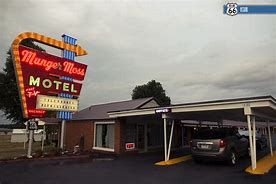
Operating motels were the Munger Moss Motel in Lebanon, Mo, Western Motel near OKC,, Blue Swallow in Tucumcari (where the daytime shot did absolutely nothing for that wondrous old sign) and Route 66 Motel (formerly the Royal Palacio) in Tucumcari.
To believe these shots, Route 66 is on its last legs with an undeniably bleak future.
Personally, I have to disagree and Will Discuss the Subject Later. --RoadDog
The March-April 2008 issue of Preservation Magazine of the national Trust for Historic Preservation had an article by Ann Beattie featuring the photography of Edward Keating who has won a Pulitzer Prize for Photojournalism.
They are in black and white and, in my opinion paint a really bleak picture of the road as it appears today. Nothing but ruins and even the places doing well look bare and sparse.
It said that Keating had "spent many hours traveling Route 66, capturing its landscapes and historic architecture." Much of the the shots were in the west, which with its vast openness, tends to always look barren and bleak, especially in black and white.
Pictures were of the La Mesa Motel in Santa Rosa, NM, two pictures of ghost town Glenrio, Texas, the cross near Groom, Tx. and an abandoned motel and the ruined Triangle Motel in Amarillo, Texas.
Operating motels were the Munger Moss Motel in Lebanon, Mo, Western Motel near OKC,, Blue Swallow in Tucumcari (where the daytime shot did absolutely nothing for that wondrous old sign) and Route 66 Motel (formerly the Royal Palacio) in Tucumcari.
To believe these shots, Route 66 is on its last legs with an undeniably bleak future.
Personally, I have to disagree and Will Discuss the Subject Later. --RoadDog
Friday, December 25, 2009
A Merry Christmas to You
I finished watching my three favorite Christmas movies earlier today. That would be #1 "A Christmas Story," #2 "Christmas Vacation" and #3 "It's a Wonderful Life."
Today, the Chicago Tribune ran its list of Top Ten Christmas Movie Favorites.
1. A Christmas Story (1983)
2. "How the Grinch Stole Christmas! (TV-1966)
3. It's a Wonderful Life (1946)
4. The Santa Clause (1994)
5. Miracle on 34th Street (1947)
6. Rudolph, the Red-Nosed Reindeer (TV-1964)
7. White Christmas (1954)
8. The Muppet Christmas Carol (1992)
9. Elf (2003)
10. Love Actually (2003)
I never heard of #10. WHAT!! No "Christmas Vacation?" By the way, this year is the 20th anniversary of "National Lampoon's Christmas Vacation." Well Done.
Happy Christmas Trails to You. --RoadDog
Today, the Chicago Tribune ran its list of Top Ten Christmas Movie Favorites.
1. A Christmas Story (1983)
2. "How the Grinch Stole Christmas! (TV-1966)
3. It's a Wonderful Life (1946)
4. The Santa Clause (1994)
5. Miracle on 34th Street (1947)
6. Rudolph, the Red-Nosed Reindeer (TV-1964)
7. White Christmas (1954)
8. The Muppet Christmas Carol (1992)
9. Elf (2003)
10. Love Actually (2003)
I never heard of #10. WHAT!! No "Christmas Vacation?" By the way, this year is the 20th anniversary of "National Lampoon's Christmas Vacation." Well Done.
Happy Christmas Trails to You. --RoadDog
Thursday, December 24, 2009
How Bad Was It?-- The Lincoln Highway in 1915-- Part 4
Continuing the "fun"trip across Iowa way back then, before "hard surface roads."
In a magazine article in Motor Age, Bement wrote that "Joy was having the time of his life...he laid on his back in 18 inches of gumbo mud with the rain in his face and examined parts to see how they were standing up."
We have pictures of them fixing a brake west of Ames, Iowa, May 31st, then adjusting them. Next, they are fording what appears to be a stream, but is actually the highway west of Boone. The water eventually got to what they called "within 10 inches of tops of fence posts."
June 1st, breakfast was again taken on the side of the road. No McDonald's Dollar breakfast selections for them.
I Think I Would Even Stick With an Interstate at This Point. --RoadDog
In a magazine article in Motor Age, Bement wrote that "Joy was having the time of his life...he laid on his back in 18 inches of gumbo mud with the rain in his face and examined parts to see how they were standing up."
We have pictures of them fixing a brake west of Ames, Iowa, May 31st, then adjusting them. Next, they are fording what appears to be a stream, but is actually the highway west of Boone. The water eventually got to what they called "within 10 inches of tops of fence posts."
June 1st, breakfast was again taken on the side of the road. No McDonald's Dollar breakfast selections for them.
I Think I Would Even Stick With an Interstate at This Point. --RoadDog
Wednesday, December 23, 2009
Not Your Ordinary House-- "A Christmas Story"-- Part 3
Sadly to say, only the exterior and backyard scenes (the Black Bart shootout) were shot here. Fake snow had to be brought in because of lack of the stuff. Interior shots were filmed on a sound stage in California. The tire changing/really bad word and tongue on the flagpole scenes were filmed in Canada.
However, owner Brian Jones, has done a great job replicating the interior to the way we remember it from the movie from the lamp, its shipping crate and the bar of soap. You don't see do not touch signs as visitors are encouraged to re-enact as many scenes as they desire. You can even sit in the kitchen cupboard where Randy. Mommie's Little Piggy, sat when he thought Dad was going to kill Raphie.
Jones, a California native, bought the house in December 2005 for $150,000, after seeing it listed on e-Bay. He spent an additional $250,000 putting it back into its movie form (it had been modernized into a duplex).
It opened Thanksgiving weekend 2006 and this past August had its 100,000th visitor. Of course, there are many others who stop by and just peek into the windows.
Definitely on My List of Places to Go. --RoadDog
However, owner Brian Jones, has done a great job replicating the interior to the way we remember it from the movie from the lamp, its shipping crate and the bar of soap. You don't see do not touch signs as visitors are encouraged to re-enact as many scenes as they desire. You can even sit in the kitchen cupboard where Randy. Mommie's Little Piggy, sat when he thought Dad was going to kill Raphie.
Jones, a California native, bought the house in December 2005 for $150,000, after seeing it listed on e-Bay. He spent an additional $250,000 putting it back into its movie form (it had been modernized into a duplex).
It opened Thanksgiving weekend 2006 and this past August had its 100,000th visitor. Of course, there are many others who stop by and just peek into the windows.
Definitely on My List of Places to Go. --RoadDog
Tuesday, December 22, 2009
Not Your Ordinary House-- "A Christmas Story"-- Part 2
The article says that even when the house is closed, folks still come by to see that holuiest of holy grails, THE MAJOR AWARD from Italy "fra-gil-le" that gave off "the soft glow of electric sex gleaming in the window."
You know, the infamous bane of Mom, the LEG LAMP!!!
It's the house of that holiday classic, and my favorite seasonal movie, "A Christmas Story."
I have lost count of how many times I have seen it, but anxiously anticipate seeing it in a few days when TBS has the 24-hour marathon starting at 6 PM Christmas Eve. Good old Ted for remembering us.
CULT CLASSIC
The 1983 movie has become a cult classic. If you're like me, you can almost say the lines as they are happening on screen. The house and its infamous furnace and questionable electric wiring, was built in Cleveland in 1895. The movie's creators were searching for a house with a 1940s feel and I'd have to say this one was perfect casting.
This one, unlike the Delta House from "Animal House" is still standing and in better shape than ever.
Not Falling for the Tongue/Flagpole Trick...Again. --RoadDog
You know, the infamous bane of Mom, the LEG LAMP!!!
It's the house of that holiday classic, and my favorite seasonal movie, "A Christmas Story."
I have lost count of how many times I have seen it, but anxiously anticipate seeing it in a few days when TBS has the 24-hour marathon starting at 6 PM Christmas Eve. Good old Ted for remembering us.
CULT CLASSIC
The 1983 movie has become a cult classic. If you're like me, you can almost say the lines as they are happening on screen. The house and its infamous furnace and questionable electric wiring, was built in Cleveland in 1895. The movie's creators were searching for a house with a 1940s feel and I'd have to say this one was perfect casting.
This one, unlike the Delta House from "Animal House" is still standing and in better shape than ever.
Not Falling for the Tongue/Flagpole Trick...Again. --RoadDog
Subscribe to:
Posts (Atom)